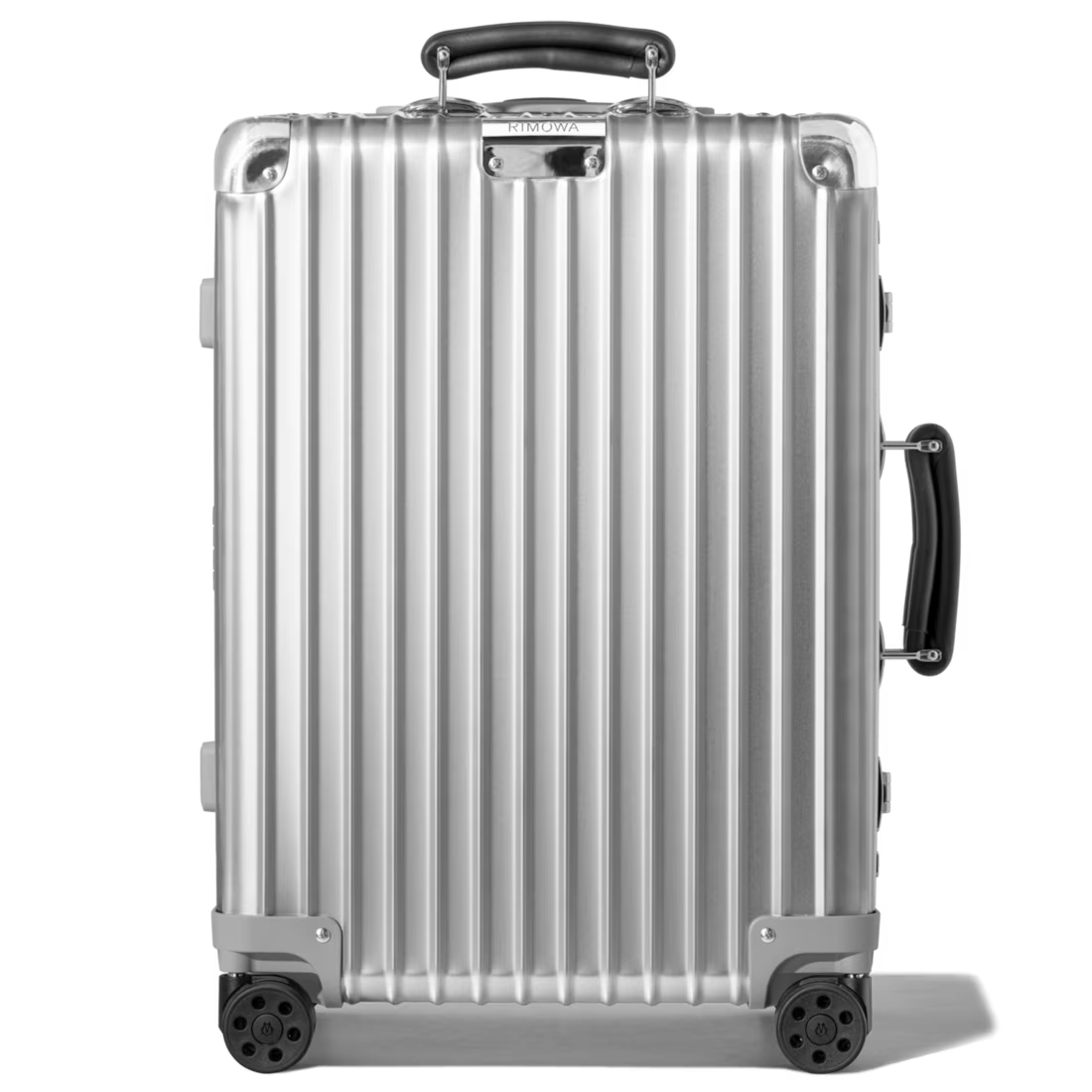
It was in the year 1898, as the 19th century rather reluctantly ceded its place to the 20th, that a German enterprise, known then simply as Rimowa, commenced its operations. Their initial métier, it should be noted, was not the sleek, ribbed aluminum cases for which they would become justly famous, but rather the somewhat more rustic art of saddle-making. Yet, even then, their underlying dedication remained steadfast: the efficient, and indeed elegant, movement of people across the terrestrial sphere.
As the horse-drawn carriage inevitably gave way to the automobile (and, subsequently, the magnificent, if slightly precarious, flying machine), the company, with a persistent, almost obsessive, line of inquiry, sought to adapt. What, they mused with a certain methodical precision, did the modern traveler truly require? What peculiar materials might best facilitate their onward journey, and which geometric forms would most effectively safeguard their various, often sentimental, possessions?
By the turn of the century, the transition from saddles to luggage was complete. Rimowa, in its industrious fervor, produced everything from the meticulously compartmentalized cases of the traveling salesman to, on one rather specific occasion, a bespoke carrying solution for a concert cello. But it was in 1937, following a regrettable, yet ultimately pivotal, conflagration at one of their German factories – where, quite remarkably, only the aluminum remained un-charred – that a new direction solidified. And by the 1950s, the company’s engineers, after much deliberation and perhaps a shared cup of strong coffee, conclusively alighted upon the very particular corrugated aluminum alloy. It was, as fate would have it, precisely the same durable, yet astonishingly lightweight, material that famously clad the legendary German Junkers JU52 aircraft. A perfect, if somewhat unexpected, choice, they concluded, for the increasingly mobile and discerning post-war voyager.

Now, turning our attention to another peculiar marvel of conveyance, we consider the Platinum Elite line of luggage. Its remarkable endurance, one might say, is a matter of pure, unadulterated pedigree. In 1987, a certain American aviator, Mr. Robert Plath by name – a man, no doubt, accustomed to the precise mechanics of ascent and descent – conceived of the two-wheeled Rollaboard suitcase. This ingenious contraption, equipped with a singular telescoping handle, possessed the rather revolutionary ability to roll alongside its proprietor whilst maintaining a dignified, upright posture. Mr. Plath, in a move of commendable entrepreneurial spirit, initially confined his sales to his fellow pilots and the various members of their airborne crews, before, in 1989, making his designs more broadly available through the newly formed Travelpro International.
Over time, as is often the case with truly groundbreaking innovations, all manner of luggage began to assume a similar, almost indistinguishable, form: a modest case upon wheels, designed solely to gather one’s sundry belongings and transport them from one arbitrary location to the next. The understated beauty, however, of Travelpro’s Platinum Elite luggage resides precisely in the utterly predictable, almost serene, manner in which it performs this otherwise rather mundane, yet undeniably essential, task.
And here, a curious detail emerges: unlike the ephemeral guarantees that typically accompany other such travel accoutrements, Travelpro’s particular assurance on this line of luggage remains steadfast, even should the capricious machinations of the airline industry somehow conspire to render it quite wrecked. (A small, yet vital, caveat: one must, with a certain diligence, remember to register one’s luggage with Travelpro.) Furthermore, for the mechanically inclined or simply the pragmatically minded, the company thoughtfully provides user-replaceable parts, allowing for the rather satisfying act of mending one’s own bag.
The fervent passion, indeed the near-obsession, that so many of our discerning readers regularly articulate for Travelpro’s luggage is, quite remarkably, mirrored by Travelpro’s own meticulous dedication to consistently meeting the often-exacting expectations of its clientele.
In the year 2021, our investigative team, with a keen eye for minor anomalies, observed a handful of discreet complaints regarding a certain fragility in the outer pocket zipper of the Platinum Elite design. One might imagine that for most commercial enterprises, such a modest collection of grievances would scarcely register as a matter of significant concern. Yet, upon a direct inquiry to Travelpro, their representatives, with a commendable forthrightness, informed us that the company had, in fact, already elevated these very complaints to the attention of its design team, meticulously tracked the peculiar issue, and, with characteristic efficiency, engineered a precise fix.
It transpired, following a thorough investigation, that an entirely unintended alteration in the production process had inadvertently resulted in an undue stress upon the zipper mechanism, particularly when the bag was, shall we say, overpacked. Zippers, it should be universally acknowledged, are, by their very nature, generally the most vulnerable component of any piece of luggage. The simplest, and indeed most elegant, method for preserving the longevity of the Platinum Elite, or indeed any suitcase one might possess, is to, on occasion, apply a thin layer of a waxy or lubricating household substance – a common lip balm, perhaps, or the humble crayon wax, or even the fine graphite shavings from a freshly sharpened pencil – to the zipper’s teeth.
 No Middle